Regional Banking Shifts and Their Effects on Digital Casino Accessibility in Major Markets
Written by Viktor Keller · Aug 20, 2026
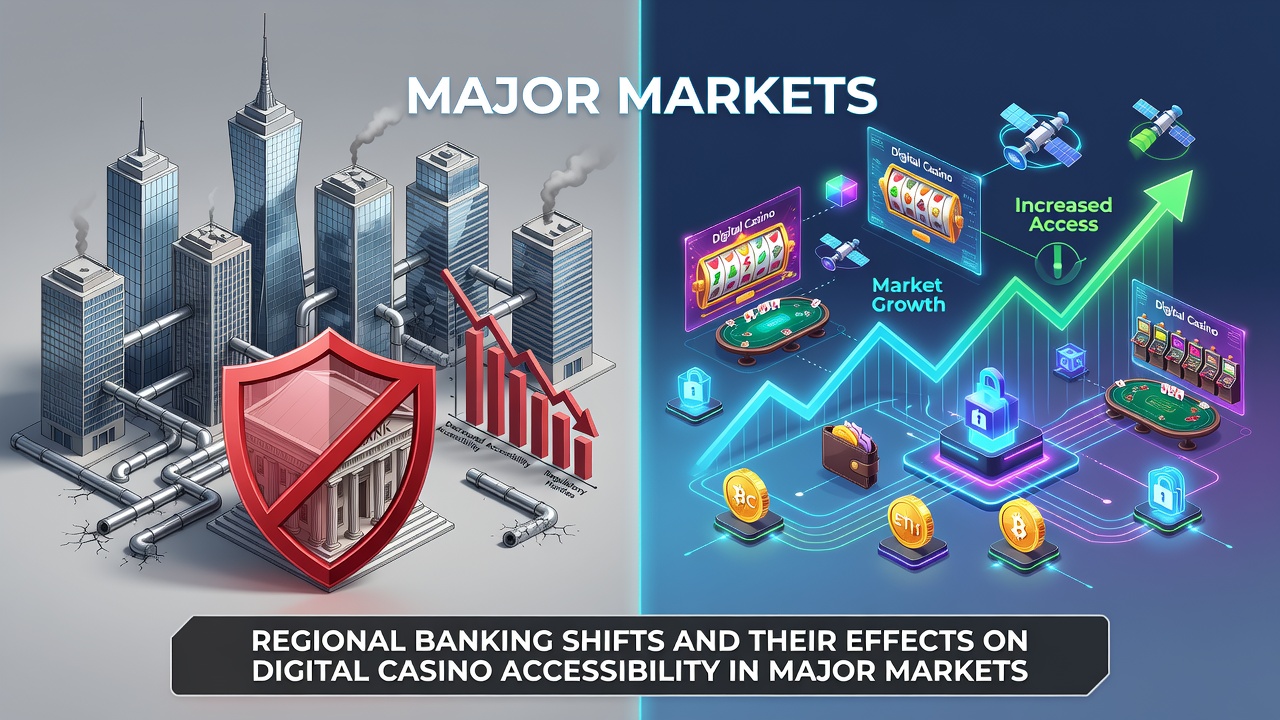
Regional Banking Shifts and Their Effects on Digital Casino Accessibility in Major Markets
Regional banking policies continue to reshape how digital casino operators handle payments and player access in key jurisdictions, with changes accelerating through mid-2026 as central banks and financial regulators adjust rules around transaction monitoring and cross-border transfers. Observers note that these adjustments often stem from broader efforts to strengthen anti-money laundering frameworks and consumer protection standards, which in turn influence the payment rails available to online gaming companies. As of August 2026, several markets have implemented updated guidelines that require banks to apply enhanced due diligence on gambling-related transactions, leading platforms to explore alternative processing methods such as digital wallets and regulated intermediaries.
North American Developments and Payment Adjustments
Banking institutions across the United States and Canada have introduced stricter categorization for electronic transfers tied to gaming accounts, prompting operators to adapt their funding options. Data from the Federal Reserve indicates that transaction rejection rates for certain merchant category codes rose noticeably between 2024 and 2026, pushing digital casino services toward partnerships with fintech providers that maintain compliance certifications. Canadian banks followed similar patterns after updates from the Office of the Superintendent of Financial Institutions, where guidelines emphasized real-time monitoring of high-velocity transfers. Players in these regions often find that direct bank transfers face longer verification windows, while e-wallet integrations and prepaid card systems maintain steadier connectivity.
European Regulatory Landscape
European markets present a varied picture because national banking authorities apply differing thresholds for gambling transaction oversight. In Germany and the Netherlands, for instance, recent directives from the European Central Bank have encouraged credit institutions to segment gaming payments into separate risk profiles, which affects settlement times and fee structures. Operators report that some traditional wire services now route through licensed payment institutions rather than direct bank channels, a shift that maintains accessibility while satisfying reporting requirements. Meanwhile, markets in Southern Europe continue to rely more heavily on local card networks that have integrated gambling-specific controls without widespread service interruptions.

Asia-Pacific Market Responses
Australian and Singaporean regulators have coordinated with domestic banks to refine rules around foreign gaming transactions, resulting in clearer pathways for licensed operators while restricting unlicensed sites. Figures released by the Australian Prudential Regulation Authority show that compliance-driven account reviews led to temporary holds on certain international transfers during 2025, after which platforms increased reliance on locally approved processors. In Japan, where digital casino expansion remains limited, banking shifts have centered on pilot programs that test tokenized payment systems under strict central bank oversight. These experiments illustrate how regional policies can either facilitate or constrain operator growth depending on the alignment between financial rules and gaming licensing frameworks.
Platform Adaptations and Player Access Patterns
Digital casino operators respond to these banking changes by diversifying their payment ecosystems, incorporating more cryptocurrency gateways in jurisdictions where such assets receive regulatory recognition. Research from academic institutions tracking transaction flows demonstrates that markets wth rapid banking adjustments often see increased adoption of instant settlement tools and multi-currency accounts. Players encounter fewer outright blocks when services route through compliant intermediaries, although verification steps have lengthened in several regions. Industry reports highlight that operators maintaining relationships with multiple banking partners experience smoother operational continuity compared with those dependent on single-channel funding.
Conclusion
Banking policy variations across major markets continue to drive measurable adjustments in how digital casino services reach players, with payment diversification emerging as the dominant response. Regulatory bodies in North America, Europe, and Asia-Pacific maintain distinct approaches that collectively shape transaction availability and processing speed. As financial institutions implement ongoing refinements, the infrastructure supporting online gaming accessibility evolves through measured adaptation rather than abrupt disruption.